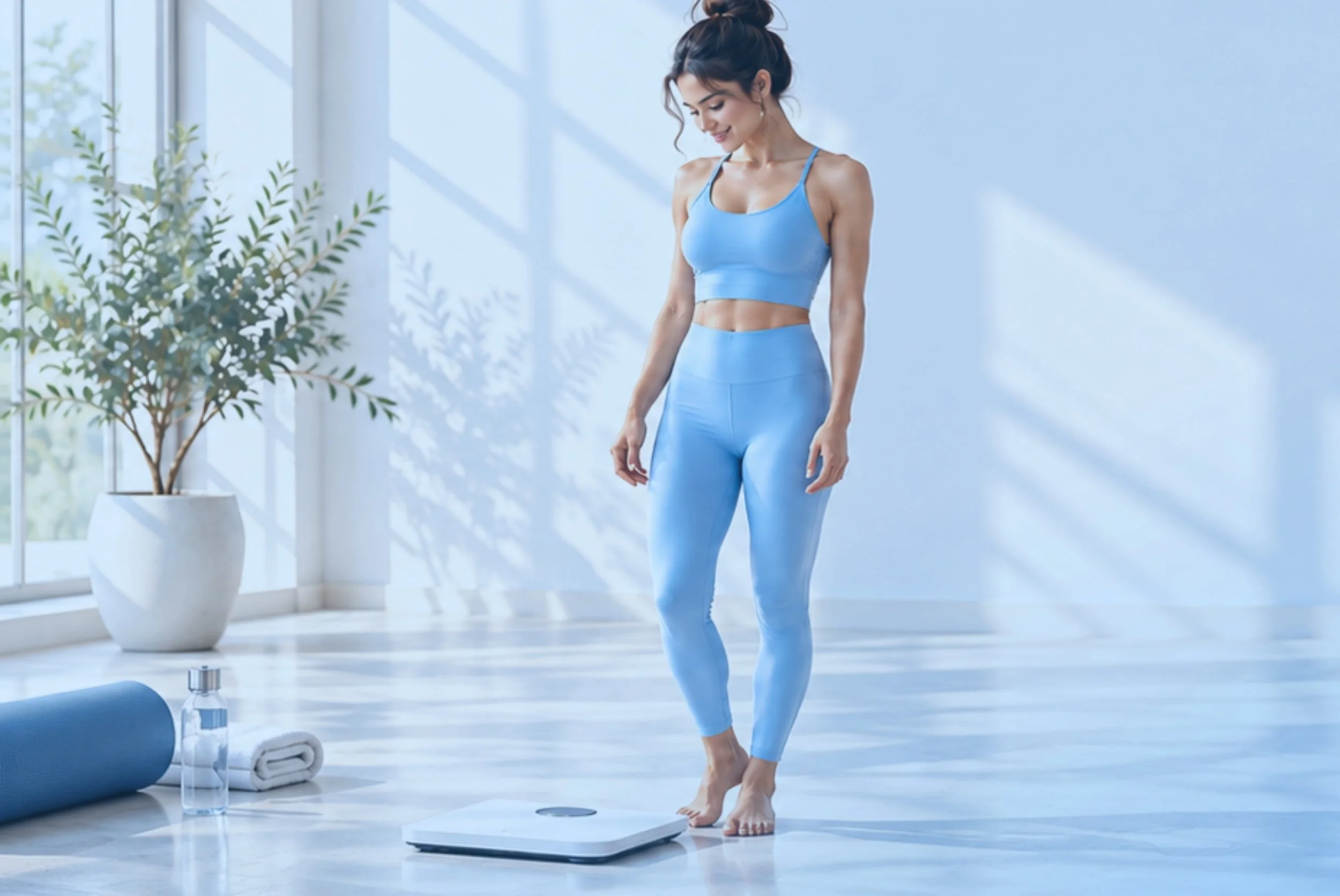
Can You Be at a Lower Weight and Still Have an Unhelpful Body-Composition Baseline?
Yes. A lower scale weight does not automatically describe how much fat or lean tissue a person has, where that tissue is distributed, or how fit the person is. Appearance, BMI, and body weight can all be useful pieces of information, but none is a complete body-composition assessment.
Weight does not identify tissue type
The scale combines everything into one total. It cannot tell whether two people at the same weight have different amounts of fat mass or lean soft tissue.
BMI has a similar limitation. It relates weight to height, which can be useful for population screening, but it does not directly measure body composition.
DEXA asks a different question
A DEXA body-composition scan at DexaFit West Houston can provide measurements of total and regional fat mass, lean soft tissue, visceral-fat estimates, and bone information. That makes it useful when the actual question is not “Am I light?” but “What is my body made of?”
That shift matters for people whose goals include strength, body recomposition, or tracking changes that may not be obvious in clothing size or scale weight.
Body composition is not the same as overall health
It is equally important not to swing too far in the other direction. A DEXA scan does not summarize every aspect of health. It does not replace cardiovascular fitness testing, laboratory work, clinical evaluation, or a person's functional abilities.
Objective measurement works best when each metric is used for the question it can actually answer.
A baseline can challenge assumptions
Some people assume they have little body fat because their weight is low. Others assume they have “too much” because they are heavier. Both assumptions can be misleading without body-composition data.
A baseline provides something more useful than a label. It creates a point of comparison. If training or nutrition changes, future testing can show whether the measured compartments changed too.
Measure before judging progress
Fitness goals become clearer when they are attached to a measurable outcome. If the goal is to improve body composition, the measurement should describe body composition rather than body weight alone.
DexaFit West Houston offers DEXA scanning along with VO2 Max, RMR, 3D body scanning, and other assessments for clients who want a broader fitness baseline.
Why appearance is a poor measurement system
People naturally make visual assumptions about fitness and body composition, but appearance cannot quantify fat mass, lean soft tissue, visceral-fat estimates, or aerobic capacity. Someone can look lean and still have questions that a scale or mirror cannot answer.
Objective testing is useful precisely because it moves the conversation away from appearance and toward measurable variables.
What a useful baseline looks like
A baseline should connect to a goal. A person interested in strength may track lean-soft-tissue trends alongside actual performance. Someone focused on body recomposition may follow fat mass and regional changes. Someone concerned with cardiovascular fitness may need VO2 testing rather than another body-composition metric.
The point is not to collect every available number. It is to select the measurements that can help evaluate the plan.
Frequently asked questions
Is BMI the same as body-fat percentage?
No. BMI is calculated from height and weight. It does not directly measure body-fat percentage.
Does a DEXA result tell me whether I am healthy?
No single test can summarize overall health. DEXA provides specific body-composition and bone-related measurements that should be interpreted in context.
Can someone at a stable weight still change body composition?
Yes. Fat and lean-tissue changes can occur without a large change in total body weight.
Curious what the scale cannot show? Schedule a DEXA body-composition scan at DexaFit West Houston.
Published by DexaFit West Houston | Dr. Gregory Burzynski | Serving West Houston & Harris County, TX | (713)834-4353
Educational purposes only. Not medical advice.